What is retail media - and why the definition depends on which side of it you're on
Retail media means something different depending on whether you're the retailer building it or the brand buying it. Here's what it actually is - and why that distinction matters.
Quick answer
Retail media is the ecosystem that allows brands to reach shoppers using a retailer's first-party data and media inventory - on their website, app, in-store, and across the connected web on virtually any digital media. For brands, it's a way to get insights and leverage customer data they don’t own, and connect media spend directly to sales. For retailers, it's a high-margin revenue stream built on data and audience they already own. The opportunity is very different depending on which side you're on.
And if you’re a customer? Retail media is hopefully the unobtrusive element that helps retailers keep investing in how they serve you and brands bring you relevant offers.
Where it started - and why it took off
Brands paying retailers to promote themselves isn't new. Shopper marketing has been around since the 1990s: end-of-aisle displays, posters, floor stickers, sampling stands. Negotiated between buyer and supplier, funded from trade budgets, and - for most of its history - impossible to measure properly. For many brands it was simply the tax of doing business.
What changed was e-commerce, then Covid. Online sales surged. Retailers suddenly had scale, traffic, and data. Third-party tools emerged to monetise that traffic. And everyone could see what Amazon was already doing - sponsored slots at the top of search results, connecting ad spend directly to purchase. Google search on steroids.
Brands got excited. Digital marketers loved the idea of connecting spend to sales. Trade teams loved the idea of finally proving what their shopper budgets delivered. And so it started largely around ecommerce - mostly with sponsored product ads, then self-serve platforms, CPC pricing, ROAS reporting, then display, then video.
What retail media actually is today
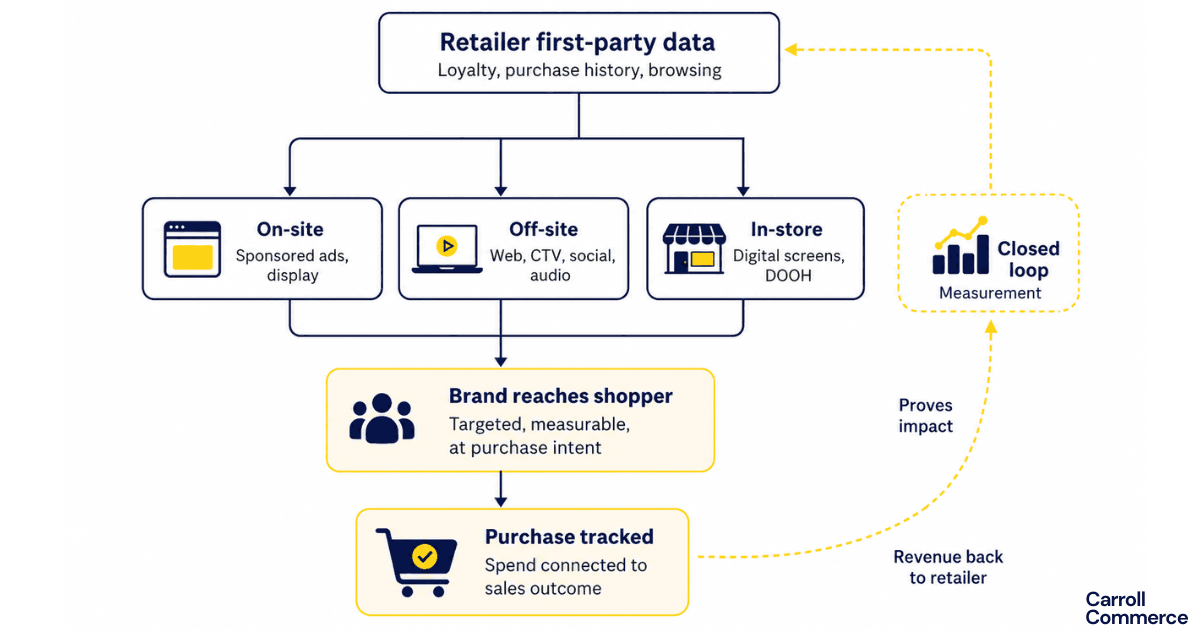
Retail media is the ecosystem that connects all of this. It starts and ends with retailer data - enabling brands to reach audiences on-site, off-site and in-store, and track behaviour across all of it.
On-site: sponsored product and display ads on a retailer's own website or app, reaching shoppers at the moment they’re showing purchase intent.
Off-site: using retailer first-party data to reach those same shoppers across the wider web, connected TV, digital radio, and social - earlier in the buying journey, before they've gone near the retailer.
In-store: digital screens replacing static cardboard, making the physical environment measurable and remotely managed for the first time.
Closed-loop measurement: the ability to track all of that media exposure back to actual purchase behaviour. This is what makes retail media fundamentally different from traditional advertising - you can see what people did, and what sold.
How the loyalty arms race is related to retail media
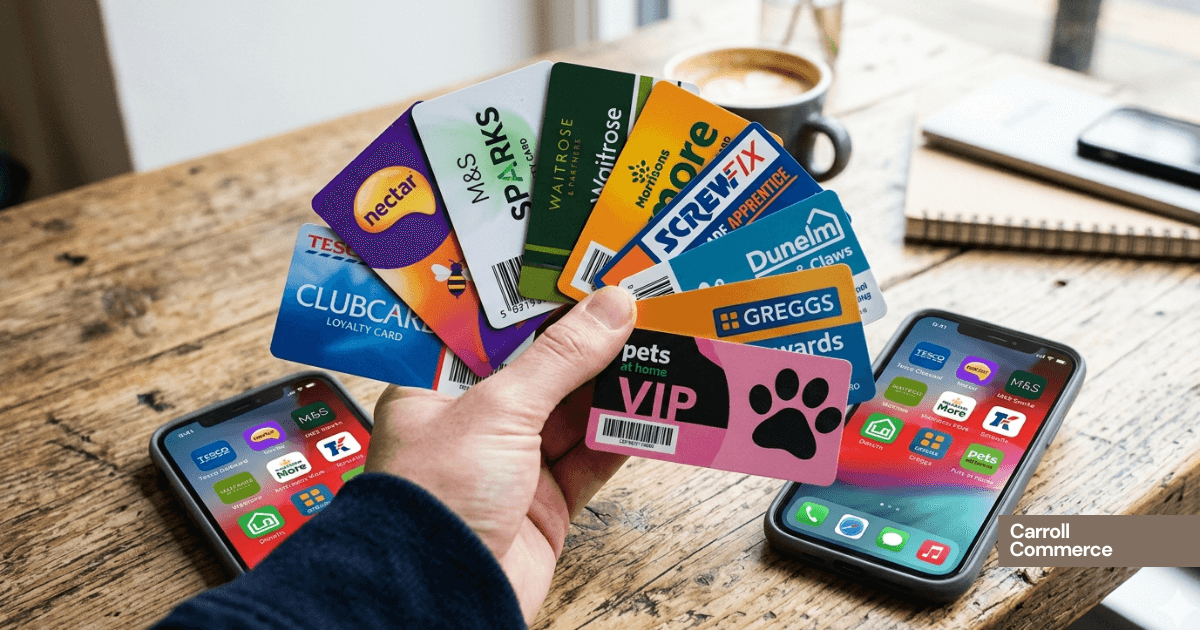
Tesco Clubcard. Sainsbury’s Nectar. M&S Sparks. myWaitrose. Morrisons More. Screwfix Rewards. Dunelm Family. Even Greggs Rewards. Every major UK retailer is now deeply motivated to know exactly who their customers are when they shop in store. Note, this is less of a problem with ecommerce or click and collect, but depending on the sector up to 80% of purchases are still going through physical stores.
That's not a coincidence. Retailers need scale, depth and recency in their customer data to make retail media work. The loyalty programme is the mechanism. If you've stood at a till recently and felt mildly coerced into downloading an app to get the price you expected - that's why.
What it means if you're a brand
Most brands rely on retailers for distribution, which means they don't have first-party data on who their actual customers are. They're competing for shelf space, and then competing again to get bought.
Retail media changes that equation. For the first time, brands can reach lapsed buyers, competitor shoppers, or people who've never tried them - using the retailer's data - and see exactly what happened next, what that spend drove in sales. The targeting is real. The measurement is real. The connection between spend and outcome is direct in a way it has never been before.
What it means if you're a retailer
The opportunity is different in kind, not just scale.
Retailers who build retail media properly - with the right operating model, commercial structure, and data infrastructure - are not just adding a revenue line. They're building a flywheel. Media revenue funds price investment. Price investment drives loyalty. Loyalty drives data depth. Data depth makes the media more valuable. The whole business gets stronger.
"Not how do we sell ads. But how do we build something that makes the whole business stronger."
Kingfisher named retail media as a margin lever in their FY results - not ancillary revenue, part of the P&L conversation. Sainsbury's CEO discussed multi-touch attribution and incrementality on an earnings call. Tesco describes their ecosystem as "the largest closed-loop media network in the UK." These aren't media businesses. They're retailers who figured out that retail media makes the core business better.
That's the definition that matters if you're on the retailer side. Not "how do we sell ads." But "how do we build something that makes the whole business stronger."
Who this is for
If you're a retail leader trying to understand what retail media could mean for your business - or a brand leader trying to understand how to make the most of it - Carroll Commerce works with both sides of this equation. Get in touch with Tara Carroll.
FAQ: What is retail media
What is the difference between retail media and shopper marketing?
Shopper marketing covers in-store promotional activity - displays, sampling, print - funded from trade budgets and historically difficult to measure. Retail media uses digital infrastructure and first-party customer data to make brand investment measurable and targeted, connecting spend directly to sales outcomes. The two often coexist inside the same retailer, which is why separating the revenue lines is an important early step for any CEO trying to understand what they actually have.
Why are retailers investing so heavily in loyalty programmes?
Loyalty programmes are the data collection mechanism that makes retail media work. To target audiences, measure outcomes, and sell closed-loop reporting to brands, retailers need to know who their customers are at an individual level. In grocery for example, where most purchases still happen in physical stores, loyalty schemes are the primary way to identify in-store shoppers. The more complete and recent the data, the more valuable the retail media proposition.
Is retail media only relevant for large retailers?
Scale matters, but it is not the only factor. A specialist retailer with deep customer engagement and a loyal audience can build a compelling retail media proposition even without grocery-scale volumes. The key ingredients are identifiable customer data, a healthy underlying business, and a supplier base willing to invest. Retailers generating under £1m of realistic retail media revenue annually should consider whether a full retail media network makes sense, or whether simpler options - data partnerships, managed services, or syndicated networks - are a better fit.
How is retail media measured?
The gold standard is closed-loop measurement - connecting media exposure directly to purchase behaviour using first-party loyalty or transaction data. This allows retailers to report sales uplift, return on ad spend, new-to-brand buyers, and incremental revenue to brand partners. Many retailers are not yet at this level and are reporting reach and click-through metrics instead, which limits the premium they can charge and the budgets they can attract.
What is the retail media flywheel?
The retail media flywheel describes the self-reinforcing cycle that the best retail media businesses create. Media revenue funds price investment. Price investment drives customer loyalty and frequency. Loyalty drives deeper data. Deeper data makes the media proposition more valuable to brands. More valuable media attracts more brand investment. The whole business gets stronger. Tesco, Sainsbury's and a small number of global retailers are operating this flywheel at scale - it is what separates retail media as infrastructure from retail media as a revenue line.